
ByJason Bittel
Published April 23, 2024
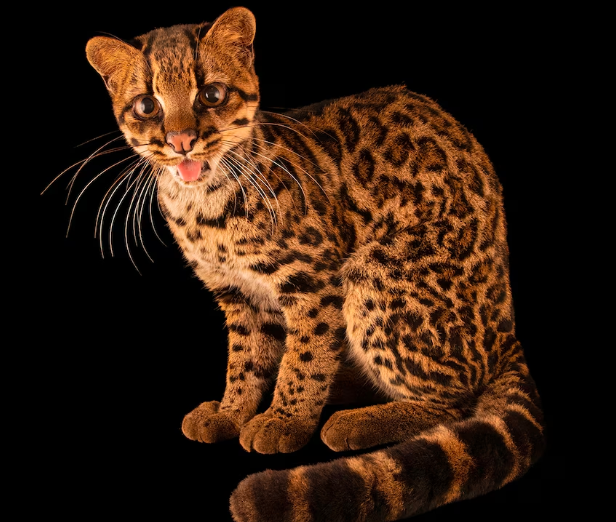
Most people are all too familiar with the lions, tigers, and other big cats of the world. But tiger-cats, which are about the size of a house cat and roam from Costa Rica to Argentina?
Truth be told, even experts get them confused.
Until now, only two tiger-cat species have been formally recognized—the northern tiger cat, or oncilla (Leopardus tigrinus) and the southern tiger cat, or southern tigrina (L. gutullus), which also has three subspecies.
But about 14 years ago, Tadeu de Oliveira received an email that made him rethink everything he knew about these small predators.
“I can even pinpoint the date,” says de Oliveira, a wildlife conservationist at the State University of Maranhão in Brazil. “It was June 22, 2010.”
The message came from researcher Rebecca Zug, who was working on spectacled bears in Ecuador and had caught some camera trap photos of a curious-looking kitty with a long tail and loads of spots—a tiger-cat unlike any other de Oliveira had ever seen. (Read about the güiña, a six-pound “mystery cat.”)
“I was mesmerized by what I saw,” he recalls.
Fast forward to 2024, and de Oliveira has teamed up with more than 40 small cat researchers to formally propose a new species known as the clouded tiger-cat (L. pardinoides), which would bring the total number of tiger-cat species to three.
The team examined 1,400 records from museums and camera traps, allowing them to compare sizes, shapes, and color patterns among tiger-cats, as as well as determine the habitats where each species lives. They also analyzed the clouded tiger-cat’s genetics to make a make an airtight case for its species status.
Despite the happy news of a new species, published recently in Scientific Reports, the scientists likewise uncovered a grim reality—each tiger-cat exists in far fewer places than once believed.
“They’ve lost more than 50 percent of their original area,” explains de Oliveira. “The red alert has been turned on.”